Why Important
It is important that these are well maintained as they provide the embellishment of the building.
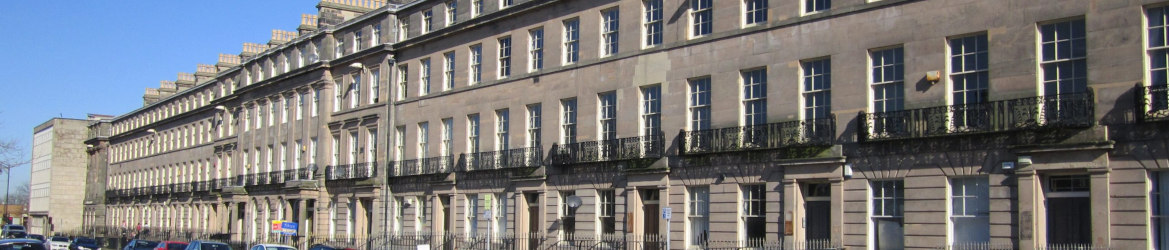
Balconies running the length of a street are tied back to the stonework with wrought- or cast-iron bars at the party walls; these ties sometimes take the form of decorative cast-iron panels fixed across the balcony to separate adjoining houses.
Being made of cast or wrought iron, they also need careful maintenance to protect them from rust.
When to look
When the initial detailed survey is undertaken. Collect photographs of the existing situation.
Undertake annual inspections or when the building has a change of use/occupancy.
What to look for
Heavier balconies are supported on a bracket of cast or wrought iron of various designs. The base and wrought-iron coping rail of the balcony itself are usually built into the wall. Because of the loads they may carry, it is particularly important that balconies be securely fixed to sound stonework, and treated against rust.
Lighter balconies usually rest on the projecting string course at first-floor level, being fixed to the stonework with lugs which form part of the floor grid, staved into undercut holes.
 Mostly the bracket is wrought-iron, fixed at top with lug set in lead, fixed at bottom by bolts grouted into masonry.
Cast iron is particularly brittle and will readily fracture if subjected to tensile stresses or if the section is significantly reduced by corrosion.
The grid floor panels (second image) of continuous balconies need to accommodate a certain degree of thermal and structural movement; welding in situ can restrict movement and cause further cracks.
 Water penetration may occur if fixings have been realigned on the wall face, leaving sinkings in the stonework.
How to fix
Sinkings in the stonework should be made good with a mortar repair.
 The hole in the stone is drilled and chiselled to a wedge shape. The balcony is positioned and a clay cup formed beneath to contain the lead. The lead is run in, pared off to the face of the stonework and staved well in. The lead must be sufficiently hot to run to the back of the sinking.
An effective temporary repair to a balcony grating floor can be achieved by bolting stainless steel plates above and below the fracture.
Avoiding creating problems
Wrought-iron brackets are susceptible to rust. Where there has been previous problems in the past, iron metal plates were often used either side of the failing bracket, and then painted. However, this often hid rust problems, which made the support weaker.
Where such ‘temporary’ repairs are found, seek professional advice. Where seriously weakened by corrosion, the bracket should be replaced with a stainless steel bracket of the same design, to keep to the heritage design.
Historical background
Builders & Architect Catalogues were often used to select finishes and styles for the original building. The Wirral Archives may be good places to research what was available at the time.
